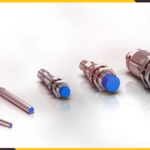
What is Capacitive Proximity Sensor ?
A Capacitive Proximity Sensor is a non-contact sensor that detects both metallic and non-metallic objects by sensing changes in capacitance.
How it works
-
Electrostatic Field Creation
The sensor has two conductive plates (one is the sensing electrode, the other is the ground reference). An oscillator applies voltage, creating an electrostatic field in front of the sensor face. -
Change in Capacitance
When an object enters this field, it changes the capacitance between the plates because:-
Different materials have different dielectric constants (ability to store electrical charge).
-
This change affects the oscillation in the circuit.
-
-
Signal Processing
The sensor’s internal electronics detect this capacitance change and trigger an output signal.
Key Features
-
Detects metals and non-metals → including plastics, wood, glass, paper, liquids, powders, and grains.
-
Can detect through thin non-metal layers (e.g., plastic container walls).
-
Adjustable sensitivity for specific applications.
-
Short to medium sensing range (a few mm to several cm depending on size).
Common Applications
-
Detecting liquid levels in bottles or tanks (through container walls).
-
Sensing plastic parts on an assembly line.
-
Counting objects like cartons or paper stacks.
-
Detecting grain, powder, or wood presence in industrial processes.
💡 Quick example:
In a packaging plant, a capacitive proximity sensor can check if a cardboard box is filled with product — even without opening it — because the product changes the dielectric value inside the box.